> For the complete documentation index, see [llms.txt](https://bdi.gitbook.io/bdi-public-documentation/llms.txt). Markdown versions of documentation pages are available by appending `.md` to page URLs; this page is available as [Markdown](https://bdi.gitbook.io/bdi-public-documentation/readme/federation-kit/interoperability.md).
# Interoperability
## 1. Introduction
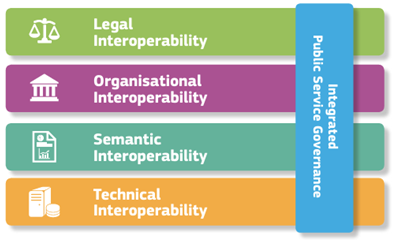
The [European Interoperability Framework](https://ec.europa.eu/isa2/sites/default/files/eif_brochure_final.pdf) describes an interoperability model that is geared toward the public sector (See Figure 1). It describes a "stack" of interoperability subjects. As a general model it is useful to describe issues and solutions.
Figure 1: Visual representation of the interoperability model
The BDI has a focus on a wide generic technical interoperability between entities, supporting specialized/differentiated:
* semantic interoperability
* organizational interoperability
* legal interoperability
The world model describes how market forces, geo politics, regulation, culture and innovation will create a dynamic universe of sectors/groups that have an interest in driving specialized/differentiated interoperability within their group, at the expense of interoperability with other sectors.
## 2. Technical Interoperability
The design philosophy to enhance generic technical interoperability is based upon the following:
* No proprietary development of protocols
* Reuse known, proven or emerging open standards in a specific configuration
* Rely on already supported digital identities and other digital proofs of claims
---
# Agent Instructions
This documentation is published with GitBook. GitBook is the documentation platform designed so that both humans and AI agents can read, navigate, and reason over technical content effectively. Learn more at gitbook.com.
## Querying This Documentation
If you need additional information that is not directly available in this page, you can query the documentation dynamically by asking a question.
Perform an HTTP GET request on the current page URL with the `ask` query parameter, and the optional `goal` query parameter:
```
GET https://bdi.gitbook.io/bdi-public-documentation/readme/federation-kit/interoperability.md?ask=&goal=
```
`ask` is the immediate question: it should be specific, self-contained, and written in natural language.
`goal` is optional and describes the broader end goal you are ultimately trying to accomplish on behalf of the user. GitBook uses it to tailor the answer towards what is most useful for that goal.
The response will contain a direct answer to the question and relevant excerpts and sources from the documentation.
Use this mechanism when the answer is not explicitly present in the current page, you need clarification or additional context, or you want to retrieve related documentation sections.